
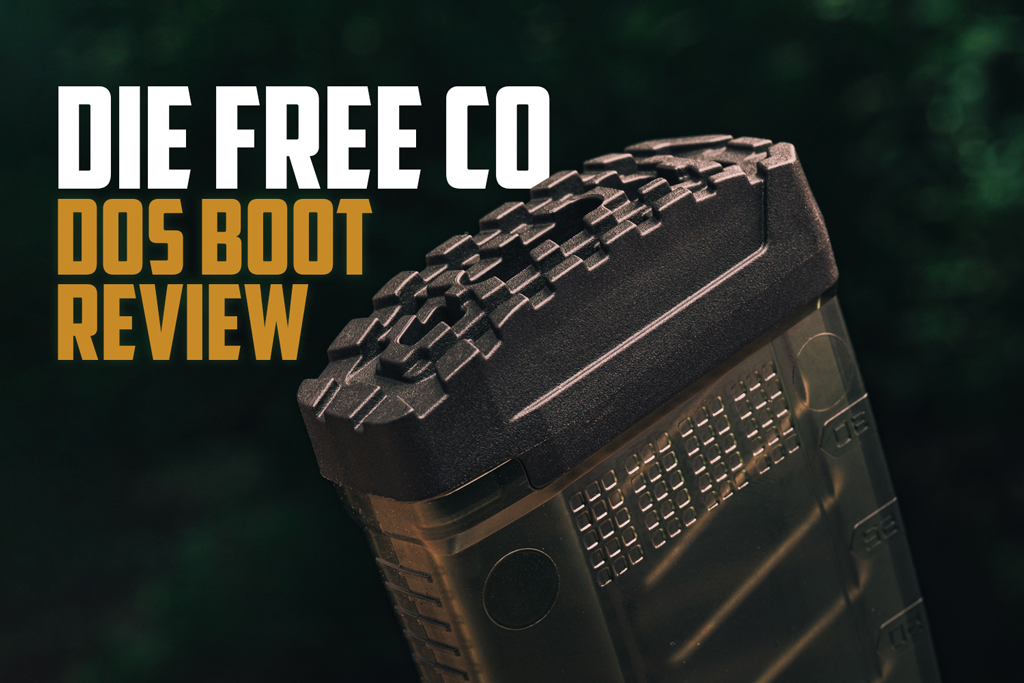
Die Free Co Dos Boot Review
Disclaimer: This page contains affiliate links, meaning we receive commissions for any purchases made through the links on this page.
Magazine baseplates aren’t exactly the most exciting accessories in the shooting world. Most people never give them much thought unless one breaks or disappears across the room during maintenance. Die Free Co Dos Boot takes a different approach, turning the humble baseplate into a functional upgrade rather than an afterthought.
Designed for Magpul GEN M3 PMAGs, the DFCO Dos Boot replaces the standard floorplate with a larger, aggressively textured polymer base. The resulting design gives you more surface area for handling the magazine while also creating a stable contact point when shooting from supported positions.
Sold as a three-pack, the Dos Boot offers a relatively inexpensive way to modify several of your existing magazines at once. Is it the right magazine accessory for you? Let’s take a look.
What Is The DFCO Dos Boot?
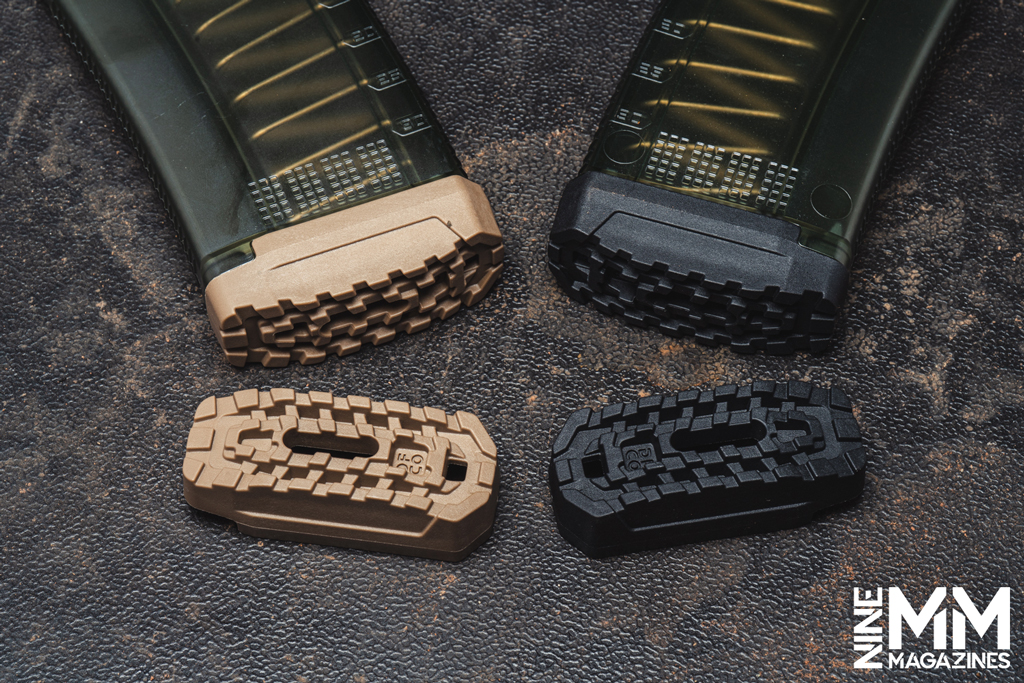
No, I’m not talking about rebooting your Windows-based computer. That’s exactly where my millennial brain went when I heard the name, Dos Boot. At first glance, the Dos Boot looks like an oversized, heavily textured PMAG baseplate. That’s essentially what it is, but the shape serves several purposes.
DFCO uses impact-resistant injection-molded polymer for the construction. The bottom features an aggressive tread pattern that looks more like the sole of a hiking boot than a traditional magazine floorplate, which explains the name.
The company also gives the bottom a convex profile rather than making it completely flat. That combination creates a larger contact surface while still allowing the rifle to make small positional adjustments when you use the magazine as a support point.
The additional material also provides more surface area for grabbing and manipulating the magazine. It’s a simple concept, but simplicity works in the Dos Boot’s favor.
Design & Concept
Although the Dos Boot fits several GEN M3 PMAG sizes, the 20-round magazine represents the configuration around which DFCO originally developed the product. The reason becomes obvious when you consider shooting position.
A 20-round magazine lets a shooter get noticeably lower than a traditional 30-round magazine when working from prone or a low supported position. Add the Dos Boot, and you get a broader, textured contact point at the bottom of the magazine without dramatically increasing its overall height.
The combination essentially creates a compact support point underneath the rifle. For bench shooting, zeroing an optic, recreational target shooting, or other supported range work, that’s an interesting feature. Rather than carrying another support accessory for casual range sessions, the magazine itself can provide another point of contact with the shooting surface.
The Dos Boot doesn’t transform a magazine into a precision shooting rest, nor should anyone expect it to replace a proper bipod or shooting bag. It simply makes an existing point of contact more useful.
Die Free Co Dos Boot: Aggressive Tread
The tread pattern may be the most visually distinctive part of the Dos Boot. Instead of using a smooth polymer surface, DFCO covers the bottom with deep, aggressive texturing.
That makes sense for a product intended to contact shooting benches, mats, dirt, grass, gravel, and other surfaces. A smooth magazine base can slide more easily, particularly on hard surfaces. The Dos Boot’s tread gives the bottom more texture and creates a broader contact area.
DFCO combines that tread with a convex shape.
A completely flat base might provide plenty of surface contact but could make small positional adjustments awkward. The curved profile allows some movement without requiring you to completely lift and reposition the rifle.
It’s a clever compromise between stability and maneuverability.
Easier Magazine Handling

The Dos Boot also changes how the magazine feels in your hand. The larger base gives your fingers more material to grab, while the aggressive texture provides additional traction.
That can prove useful when handling magazines with wet, sweaty, or gloved hands. It can also make magazines easier to grab from certain pouches or storage compartments.
The difference becomes particularly noticeable on shorter magazines. A 20-round PMAG doesn’t provide as much gripping surface as a 30- or 40-round magazine. Adding a slightly larger, aggressively textured base gives you another obvious contact point.
The Dos Boot’s distinctive profile can also make equipped magazines easier to identify by touch inside a range bag or pouch.
Abuse It (Go Ahead)
Magazine baseplates live a rough life. They get dropped onto concrete, gravel, dirt, and range floors. They bang against other equipment inside bags and cases. During training and competition, magazines may hit the ground repeatedly throughout the day.
DFCO addresses that reality with impact-resistant injection-molded polymer construction. That’s the right material choice for this application. Polymer keeps weight relatively low while providing enough flexibility and impact resistance to handle normal range abuse.
Existing user reports support that idea. Owners have reported dropping Dos Boot-equipped magazines onto surfaces including gravel and concrete without experiencing significant problems.
Of course, no polymer component is indestructible. The important consideration is whether the accessory feels appropriately designed for the environment where people will actually use it.
Installation & Compatibility
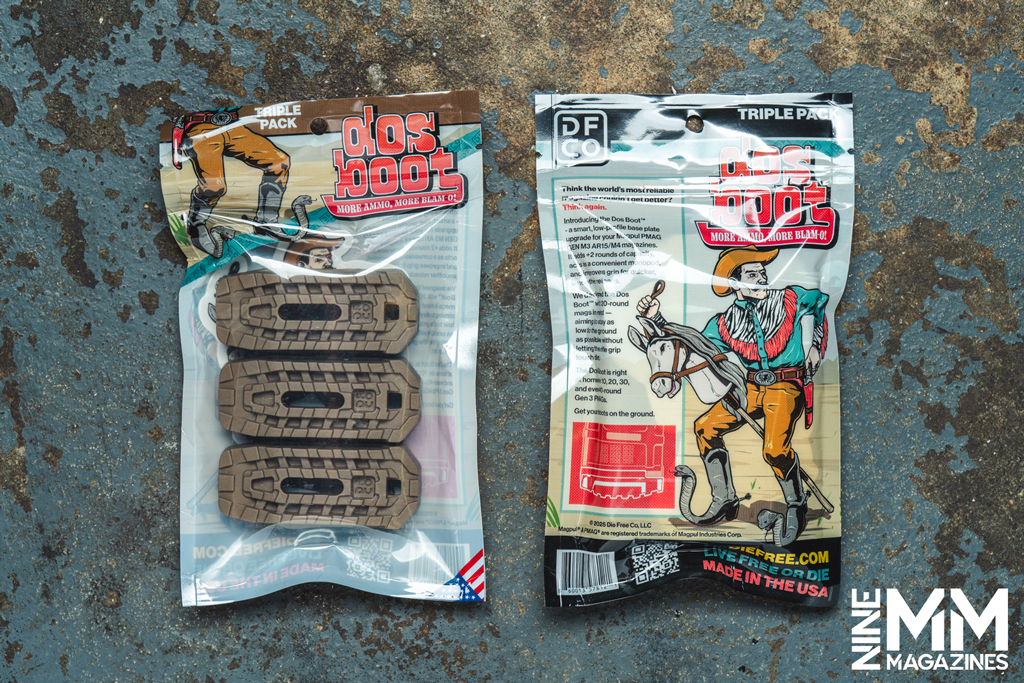
DFCO designed the Dos Boot as a replacement component for Magpul GEN M3 PMAGs rather than a universal magazine accessory. According to the manufacturer, it works with GEN M3 PMAGs in 10-, 20-, 30-, and 40-round configurations. That broad compatibility gives owners plenty of flexibility.
You might prefer the Dos Boot on 20-round magazines for bench and prone shooting while putting another one on a 30-round magazine simply for the improved gripping surface. As mentioned, the three-pack format makes that experimentation easier. You can equip several magazines and decide which configuration works best for you.
As a bonus, the Dos Boot provides a +2 round capacity bump to all compatible PMAG magazines. More ammo capacity is good. Can’t complain about that.
Colors: Black, ODG, Coyote
DFCO currently offers the Dos Boot in Black, OD Green, and Coyote Brown. It makes sense, as those colors line up with Magpul’s standard releases.
Black provides the obvious choice for anyone who wants the accessory to blend naturally with a standard black PMAG. Coyote Brown adds some contrast and works nicely with rifles and accessories built around earth-tone colors.
Considering how popular OD green has become for rifle furniture and accessories, it’s a no-brainer to have int he lineup. I wouldn’t mind seeing some other color options, or even camo patterns in the future. Adding limited-run camo options would certainly make sense. Hopefully, we’ll get that and more color options from DFCO in the future.
Made In The USA
The Dos Boot is made in the United States (Yay!), which will appeal to shooters who prioritize domestically manufactured accessories. Die Free Co. operates out of New Hampshire and has developed a recognizable lineup of polymer rifle accessories.
The Dos Boot fits that product philosophy well. It doesn’t radically change the equipment it’s attached to. Instead, DFCO takes an ordinary component and tweaks the ergonomics and functionality.
Sometimes those small upgrades prove more useful than accessories that attempt to reinvent everything.
Value Proposition
DFCO sells the Dos Boot in packs of three for around twenty bucks. That’s arguably the right approach for a magazine accessory because most gun owners buy magazines in bulk. A three-pack allows you to set up a small group of magazines consistently rather than modifying just one.
However, (as I glance at the boxes and boxes of magazines by my desk) I do have some concerns about the value. At around seven dollars per baseplate before shipping or taxes, it’s going to be an investment to put these on every PMAG you own. Gen 3 PMAGs sell for between $12-$15 each, so for those with stacks of magazines, the investment will have to make sense for you to go all-in on them.
They are less expensive than Magpul’s Ranger Plates (which have an MSRP of $24.95 for a 3-pack), so it comes down to how much you want to spend to customize your loadouts. It may be better to mix and match your magazine plates to fit your mission and budget.
Considering the construction and additional functionality, the pricing seems reasonable for shooters who already own compatible GEN M3 PMAGs.
Pros & Cons
Pros
- Impact-resistant injection-molded polymer construction
- Aggressive tread provides a substantial contact surface
- Convex bottom helps with small positional adjustments
- Larger base improves magazine handling
- Provides a +2 magazine capacity to your PMAGs
- Compatible with GEN M3 10-, 20-, 30-, and 40-round PMAGs
- Useful as a support point during bench or prone shooting
- Three-pack lets you outfit multiple magazines
- Made in the USA
- Reasonable price for a three-pack
Cons
- Only compatible with specified Magpul GEN M3 PMAGs
- Adds some size to the bottom of the magazine
- Benefits may be less noticeable on larger magazines
- Currently limited to three colors
- Doesn’t replace a dedicated bipod or shooting rest
Dos Boot Is Good?
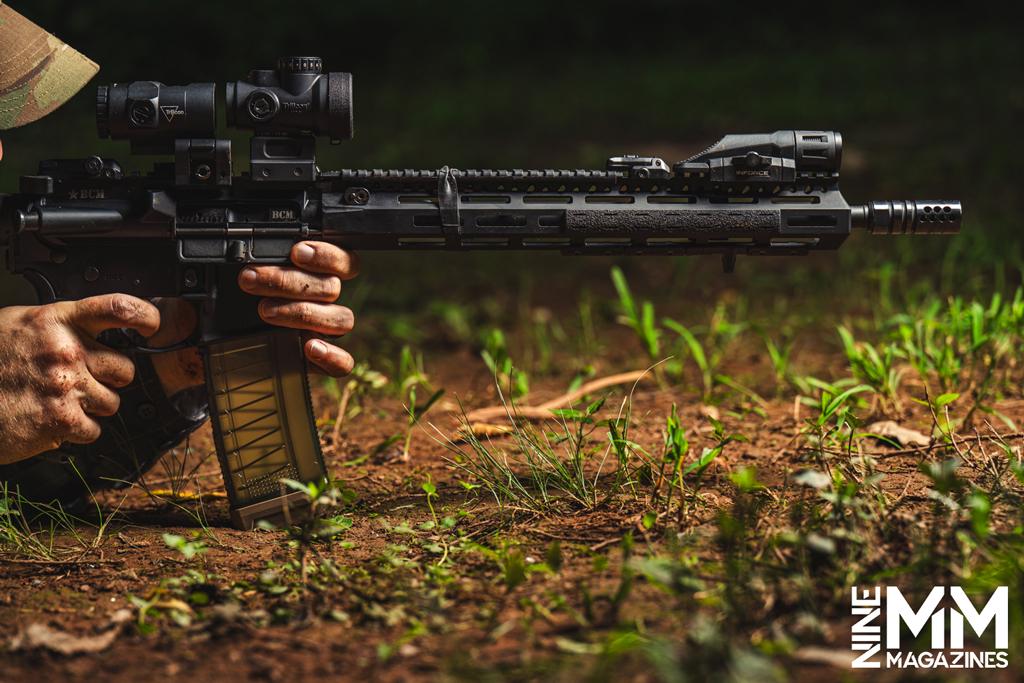
The Die Free Co. Dos Boot represents the kind of accessory that initially seems unnecessary but starts making more sense once you look at the details. DFCO hasn’t tried to reinvent the PMAG. Instead, the company focused on one overlooked component, the baseplate, and asked how it could make that part more useful.
The aggressive tread creates a better contact surface. The convex profile makes positional adjustments easier. The larger footprint provides more material to grab when handling magazines. And on a 20-round PMAG in particular, the design creates a useful support point while keeping the rifle relatively low.
Not everyone needs upgraded baseplates. If your magazines spend most of their time going between a range bag and a shooting bench, standard PMAG floorplates already work perfectly well.
Shooters who regularly use 20-round PMAGs, shoot from prone or supported positions, participate in competitions, or simply appreciate thoughtful improvements to their equipment have more reason to take a look.
The Dos Boot succeeds because it doesn’t overcomplicate anything. It’s a rugged piece of molded polymer that gives an existing component better ergonomics and additional utility.
My overall rating of the Die Free Co Dos Boot: 4.5/5 

- Black
- Gen M3
- 5.56*45

Looking for more info on gun magazines? Check out our guide to the parts of a gun magazine.