


Baseline Dryfire: Guide To Red Dot Mastery Review
Disclaimer: This page contains affiliate links, meaning we receive commissions for any purchases made through the links on this page.
Baseline Dryfire: Guide to Mastery is a practical training manual aimed at helping shooters. From beginners to more experienced practitioners, you’ll find knowledge to build real skill through structured dry-fire practice. Written by competitive shooter and instructor Ben Stoeger with co-author Joel Park, the book positions itself as a roadmap for purposeful training. It navigates you through what might seem like mundane practice and helps you turn it into measurable progress.
At roughly 179 pages, the book isn’t overloaded with complex concepts. Instead, it’s concise, accessible, and designed to be used in conjunction with training, rather than merely read. Its subtitle, Guide to Red Dot Mastery, reflects the core purpose, helping shooters understand how to effectively train with pistol-mounted red dot optics using dry-fire drills that can be done safely at home or in a controlled practice area.
Baseline Dryfire: Overview
The rise of red dot optics in both competitive and defensive shooting has reshaped how shooters train fundamentals. Unlike traditional iron sights, a red dot requires a slightly different presentation, visual engagement, and motor programming. Learning these concepts can be difficult for new shooters. Stoeger’s book recognizes this and attempts to distill dry-fire training into a structured process that improves:
-
Grip & Index
-
Visual Focus & Target Acquisition
-
Presentation Mechanics
-
Trigger Control
-
Consistency & repeatability
(all without costly live fire)
The writing is organized into digestible sections that break basic mechanics into understandable parts, and then into drills that reinforce them. These drills aren’t just lists of mechanical exercises; they are purpose-driven training tools designed to build “real ability” instead of simply burning time practicing random reps. Ben’s philosophy on dry fire is clear, it’s not about mimicking live fire perfectly; it’s about improving your skills with your pistol in an environment where errors are more visible and improvement is more controllable.
The Learning Concepts

1. Practical, Efficient Training Focus
One of the strongest elements of Baseline Dryfire is its insistence on purposeful practice. Too often, shooters dry fire without clear objectives, repeating movements without assessing what’s working or what’s not. Stoeger and Park aim to change that by encouraging structured sessions with objectives and measurable improvement. This emphasis on quality over quantity is a refreshing departure from dry-fire routines that lack context. It’s not just about practicing, it’s about practicing right and using what you learn as a corrective tool.
2. Accessibility (Shooters of All Levels)
Whether you’re brand new to red dots or transitioning from iron sights, the book doesn’t assume prior expertise. It walks readers through the fundamentals in an approachable way. It guides you without condescension, making it especially useful for beginners or those who aren’t entrenched in competitive shooting communities. For newer shooters, the book is easy to read and follow, and well worth the price for concise, actionable instruction. Experienced shooters may already be familiar with a lot of the concepts; however, the book acts as a primer, making it easy to brush up on forgotten skills and get back to the basics of practical shooting.
3. Focus on Skill, Not Gimmicks
Another strength is that the book doesn’t push expensive gadgets or fancy training tools. Instead, it emphasizes basic fundamentals, including grip, presentation, and visual focus, which are directly trainable with minimal equipment. All you need to get started is a belt, a holster, and a gun. How far you want to take it from there is up to you. This keeps the cost of entry low and the focus squarely on developing ability rather than buying gear. If you watch Ben’s videos, you already know his approach: It’s not the gear that makes you better, it’s your training (but looking cool helps too).
4. Modernized for Red Dots
Stoeger’s previous dry-fire manuals were excellent at teaching fundamental mechanics for iron sights; this book explicitly updates those approaches for red dot optics. That modernization is one of its selling points: dry-fire training that acknowledges how most modern shooters are actually training and competing today. It’s not about solving red dot issues with equipment changes, but rather solving them with improved technique. While much of the core philosophy echoes Stoeger’s earlier work, it is adapted in ways that highlight presentation and visual engagement specific to red dot use.
Is It Worth Buying?
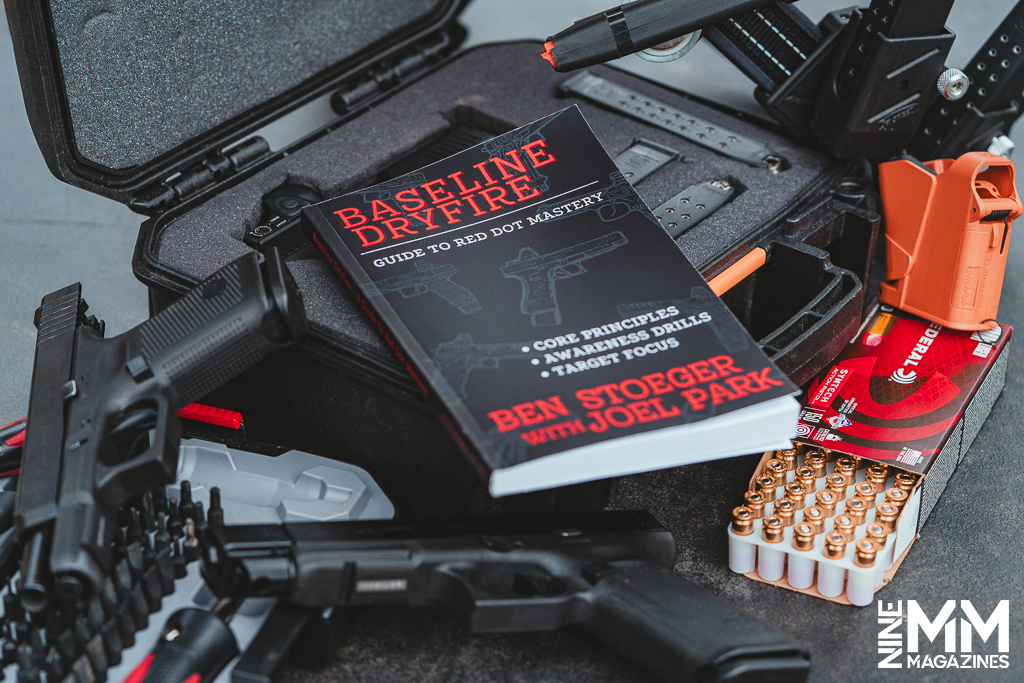
One consistent theme in community feedback we’ve read is that if you’re already steeped in Stoeger’s methods (or similar dry-fire philosophies), Baseline Dryfire: Guide to Mastery might not deliver radical new insights. Some readers have observed that the material can feel like a consolidation of concepts Stoeger has shared in previous books and videos. For experienced competitors or dedicated practitioners already logging dry-fire hours with structured systems, the book may feel more like a refresher than a breakthrough. However, if you need all of this information compiled in a single, easy-to-navigate reference, it’s a no-brainer to pick this one up.
Key Takeaways
Overall, Baseline Dryfire: Guide to Red Dot Mastery is a practical, effective dry-fire guide grounded in decades of competitive shooting experience. Its greatest asset is its structured approach, teaching shooters not just what to practice, but how and why to practice it. For beginners and intermediate shooters, especially those transitioning to red dot optics, the book offers a clear path forward that can accelerate progress and build confidence with consistent training.
While it may not be revolutionary for long-time students of Stoeger’s work, it succeeds as a fundamentals-based training manual that places purpose over repetition and real ability over gimmicks. If nothing else, it’s an excellent point of reference that can be used as a time-saver for refreshing your knowledge and skillset. It’s concise, digestible, and grounded in real-world shooting demands, and for less than the price of a USPSA membership, it delivers considerable value as a training companion book.
Who’s It For?
- New shooters just starting with red dot optics
- Concealed carriers aiming to build consistent skill without wasting ammo
- Shooters seeking structured dry-fire training, rather than random reps
- Competitive shooters who want a simple, red-dot-specific, updated reference
Shooter Ready?

Baseline Dryfire is a useful, well-organized dry-fire training manual that effectively translates foundational shooting principles into drills. These comprehensive drills are ideal for shooters aiming to master red dot optics. It’s practical, accessible, and written with a focus on developing real, range transferable skills. Once learned, you’ll be finding your dot with confidence and hitting targets faster than a holstered Sig P320. These qualities alone make it a valuable resource in any serious shooter’s library, even if it isn’t a dramatic departure from the best of what Stoeger has already put forth.
My overall rating of Baseline Dryfire: Guide To Red Dot Mastery: 5/5 
Looking for more book reviews? Check out our review of Glock: The Rise Of America’s Gun at this link!